Independent practice site — not affiliated with Immigration, Refugees and Citizenship Canada or the Government of Canada. The official study guide is free on Canada.ca.
This independent lesson is a study aid. Discover Canada is the free official guide.
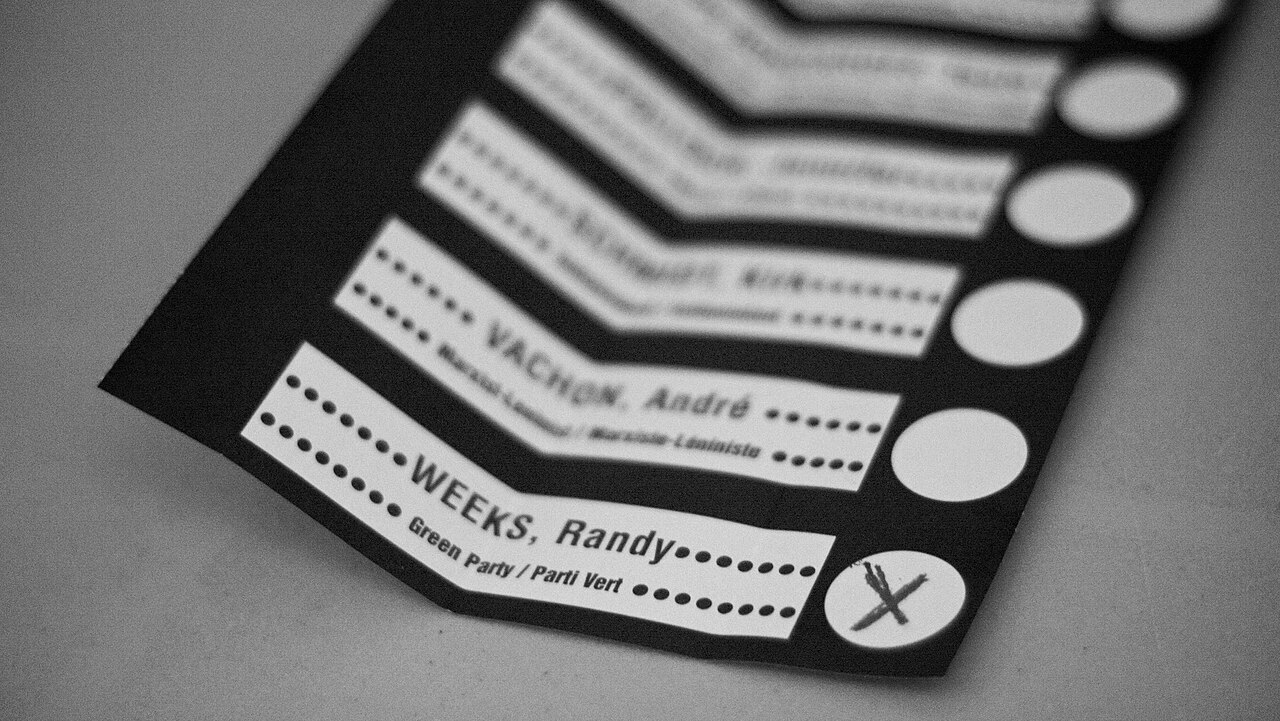
ARCHIVE · 2008 FEDERAL ELECTIONBallot from the Calgary West riding in the 2008 federal election. A historical example, not a current ballot or instructions for voting today.Photo · D'Arcy Norman · Wikimedia Commons · CC BY 2.0 · Resized copy for the web; display may crop to fit the screen.
Left side: names and parties
Each row names a candidate and party. The photograph shows only part of the 2008 Calgary West ballot.
Circles to the right of the names
The X in the bottom circle illustrates one choice. Voting takes place in private; follow the instructions for the current election.
Who can vote and run
In plain language
To vote in a federal election, you must be a Canadian citizen and at least 18 years old on voting day. Elections Canada maintains the voters’ list. An eligible voter can be added even on election day; not receiving a voter information card does not remove the right to vote. Canadian citizens aged 18 or older may run as candidates.
Picture it
A citizen who has just turned 18 checks their registration before voting. If their name is missing, they ask Elections Canada how to be added.
Ask yourself
Does a missing voter information card mean you cannot vote?
From riding to MP
In plain language
A riding is a geographical electoral district. Voters in each riding choose among candidates. The candidate with the most votes becomes its member of Parliament (MP) in the House of Commons. Voters choose a local candidate, not a prime minister directly.
Picture it
In an illustrative riding, Candidate A receives 4 votes, B receives 3 and C receives 2. A becomes the MP even though A did not receive more than half of all votes.
Ask yourself
Who becomes the MP when no candidate wins over half the votes?
A private ballot
In plain language
The secret ballot protects your choice. You mark your ballot in private; no one may demand to know whom you chose. You may tell someone voluntarily. Election workers count ballots after polls close.
Picture it
A family member can ask how you voted, but cannot insist that you answer.
Ask yourself
Who may require you to reveal your vote?
How voting works
In plain language
Check when and where to vote with Elections Canada, and bring accepted proof of identity and address. At the polling place, receive a ballot, mark one candidate privately, fold it and place it in the ballot box as directed. Advance polls and special ballots offer other ways to vote.
Picture it
If you cannot vote on election day, check the official instructions for an advance poll or special ballot.
Ask yourself
What happens between receiving a ballot and putting it in the box?
After the votes are counted
In plain language
Seats in the House of Commons are won riding by riding. Ordinarily, the leader of the party with the most seats is invited to form a government. A majority government holds more than half the seats; a minority government holds fewer and needs support from other MPs to keep the confidence of the House. Parties outside government form the opposition and question or seek to improve its proposals.
Picture it
If no party holds more than half the seats, a government can still govern while it has the House’s confidence. The opposition continues to scrutinize it.
Ask yourself
How can a minority government continue to govern?
FROM BALLOT TO HOUSE
One riding, one MP: the voting journey
The historical ballot shows candidate names and circles for marking a choice. Details of a real election can change; always follow official instructions.
01
Check eligibility
A citizen who is at least 18 on election day may vote. Check current instructions with Elections Canada.
02
Choose in private
In your riding, mark the ballot privately for one candidate. The 2008 ballot above is a historical example.
03
Count the votes
After polls close, ballots are counted. The candidate with the most votes wins the riding.
04
Elect an MP
Each riding sends one elected member to the House of Commons. Your ballot does not directly elect the prime minister.
A way to remember
Follow the path: eligible voter → secret ballot for a candidate → one MP for the riding → seats in the House → government and opposition. The ballot chooses an MP, not the prime minister directly.
Check your understanding
Can a registered voter vote only if a voter information card arrives?
No. An eligible citizen can be added to the voters’ list, including on election day. Check current instructions with Elections Canada.
Does the winning candidate need more than half the votes in a riding?
No. The candidate with the most votes wins the riding, even without an absolute majority of votes.
What is the opposition’s role?
Parties not in government question government decisions and may oppose or seek to improve proposals.
Help us improve this site with Firebase Analytics. We send page visits, broad diagnostic milestones and confirmed paid study purchases only if you agree. Privacy Policy