Independent practice site — not affiliated with Immigration, Refugees and Citizenship Canada or the Government of Canada. The official study guide is free on Canada.ca.
This independent lesson is a study aid. Discover Canada is the free official guide.
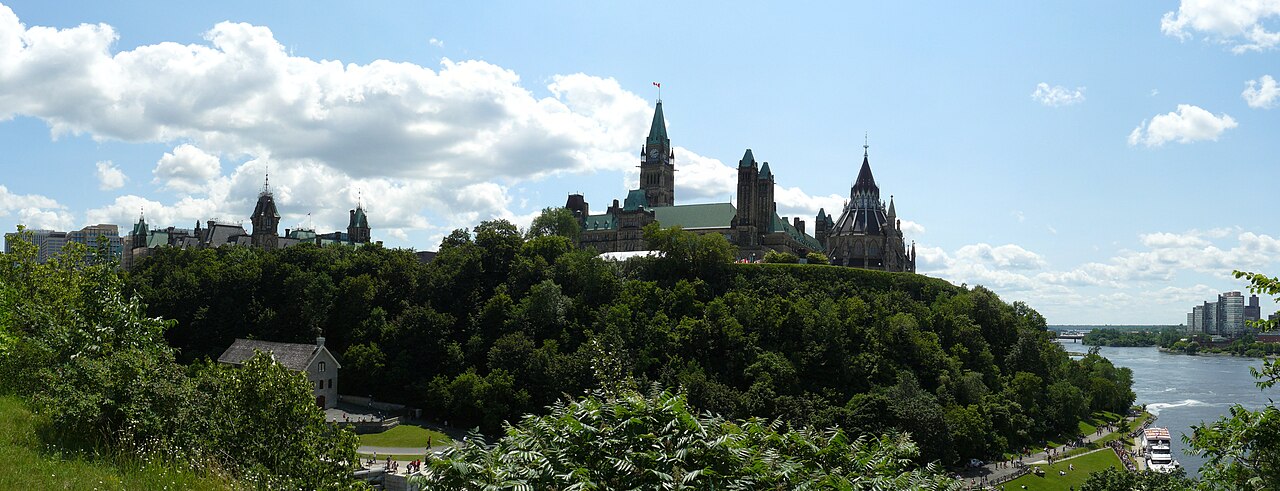
Parliament Hill in Ottawa on Canada Day, 2008.Photo · Raul Heinrich · Wikimedia Commons · CC BY-SA 3.0 · Resized for the web; no other changes.
A federal state: responsibilities are shared
In plain language
The federal government handles national and international matters such as citizenship, defence and criminal law. Provinces handle areas including education, health and natural resources. Territories govern many of the same day-to-day matters under powers delegated by the federal government. Municipal governments provide local services under provincial law. The federal and provincial governments share responsibility for immigration and agriculture.
Picture it
For a citizenship question, think federal. For a public school, think provincial or territorial. For local garbage collection, think municipal.
Ask yourself
Which level handles citizenship, and which usually handles education?
A parliamentary democracy: elected representatives answer to voters
In plain language
Citizens elect members of the House of Commons and provincial or territorial legislatures. At the federal level, the House of Commons is the elected part of Parliament. Members debate laws, approve spending and hold the government to account. The government must keep the confidence of the House of Commons to govern.
Picture it
If the House defeats the government on a confidence vote, the government must resign or seek an election.
Ask yourself
Which part of Parliament is elected by voters, and what does confidence mean?
A constitutional monarchy: two different leaders
In plain language
The Sovereign is Canada’s head of state and acts according to the Constitution. The Governor General represents the Sovereign federally; a Lieutenant Governor does so in each province. The Prime Minister is the head of government and directs federal policy. These are different roles.
Picture it
The Prime Minister chooses Cabinet ministers to run government departments. The Governor General carries out constitutional duties such as granting royal assent to federal bills on behalf of the Sovereign.
Ask yourself
Who is head of state, and who is head of government?
Parliament, Cabinet and a new law
In plain language
Federal Parliament has three parts: the Sovereign, the Senate and the House of Commons. Cabinet is the Prime Minister and ministers who direct government work; it is not a fourth part of Parliament. A bill is studied and passed by both the House and Senate, then receives royal assent before it becomes law.
Picture it
A proposed federal law is debated in the elected House and reviewed by the Senate. After both pass it, the Governor General can grant royal assent for the Sovereign.
Ask yourself
Name Parliament’s three parts. What final step turns a passed bill into law?
Federal state
Three levels of government
Compare where each level acts. Some areas, including immigration and agriculture, are shared by federal and provincial governments.
01
Federal
Across Canada
Citizenship, defence and criminal law
02
Provincial or territorial
Within a province or territory
Education, health and natural resources
03
Municipal
Within a local community
Waste collection and other local services
Who does what federallySovereign → head of stateRepresented by the Governor General; part of Parliament.House of Commons + Senate → ParliamentThe House is elected; both chambers consider bills.Prime Minister + Cabinet → governmentDirect policy; must retain the House’s confidence.
A way to remember
Federal state = who handles which work. Parliamentary democracy = voters choose representatives and the government needs the House’s confidence. Constitutional monarchy = the Sovereign is head of state; the Prime Minister heads government. For a bill: House + Senate + royal assent.
Check your understanding
Who is responsible for citizenship and public education?
Citizenship is a federal responsibility. Education is a provincial responsibility; territorial governments also run education under delegated powers.
Is Cabinet one of the three parts of Parliament?
No. Parliament consists of the Sovereign, the Senate and the House of Commons. Cabinet, led by the Prime Minister, directs the government and must retain the confidence of the House.
What must happen after both chambers pass a federal bill?
It must receive royal assent, usually granted by the Governor General on behalf of the Sovereign, before it becomes law.
Help us improve this site with Firebase Analytics. We send page visits, broad diagnostic milestones and confirmed paid study purchases only if you agree. Privacy Policy