Independent practice site — not affiliated with Immigration, Refugees and Citizenship Canada or the Government of Canada. The official study guide is free on Canada.ca.
Where do Canadian rights come from? Follow the path from legal traditions to the Constitution and the Charter, then test the ideas with everyday examples.
Canadian law draws on laws passed by Parliament and provincial legislatures, English common law, French civil law and constitutional traditions inherited from Britain. Common law grows through court decisions; civil law is organized in a written code.
Picture it
A legislature passes a law. A court interprets it. Both help shape the rules people live by.
Ask yourself
Can you name two sources of Canadian law?
A long tradition of liberty
In plain language
The guide connects Canadian freedoms to Magna Carta, signed in England in 1215. It also names habeas corpus, a common-law protection that lets someone challenge unlawful detention by the state.
Picture it
If a person is held without lawful grounds, they can ask a court to examine the detention. That is the idea behind habeas corpus.
Ask yourself
What can someone challenge through habeas corpus?
The Constitution and the Charter
In plain language
The Constitution sets foundational rules for Canada. In 1982, it was amended to include the Canadian Charter of Rights and Freedoms. The Charter protects fundamental freedoms and sets out additional rights.
Picture it
A peaceful gathering to express an opinion connects to freedoms of expression and peaceful assembly. These are Charter freedoms.
Ask yourself
What was added to the Constitution in 1982?
Rights in daily life
In plain language
The guide highlights mobility rights, official-language and minority-language education rights, and protections for Indigenous peoples’ treaty and other rights. It also discusses multiculturalism and equality of women and men under the law.
Picture it
A citizen choosing to live and work in another province uses mobility rights. French and English have equal status in Parliament and throughout the federal government.
Ask yourself
Which right relates to living and working anywhere in Canada?
THE DOCUMENT AND THE IDEA
Explore the Charter
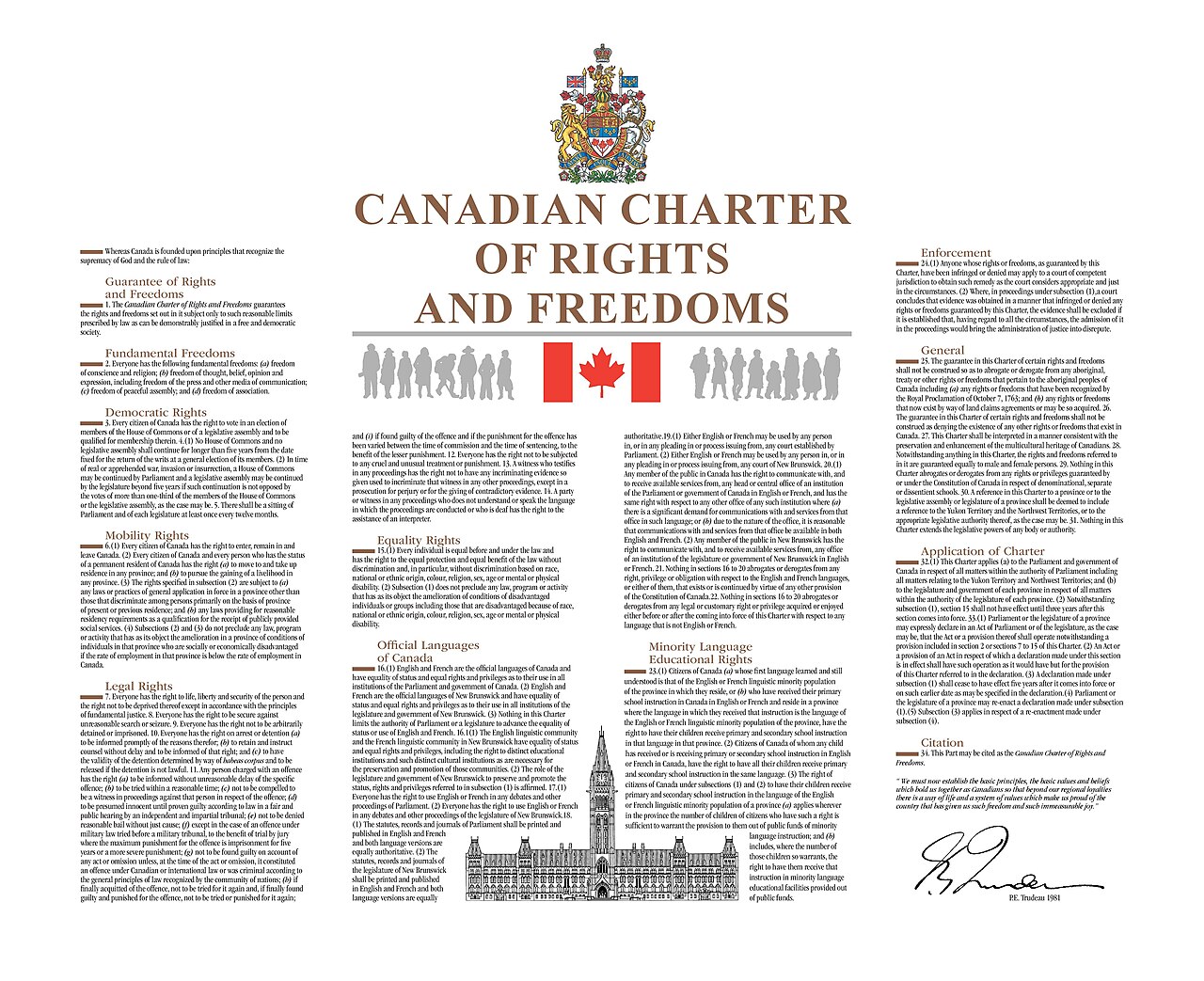
Use these three notes to connect the document to the rights explained in this lesson. The document image is a visual reference; the same ideas are explained in text.
01At the top of the document: its title
The large heading identifies the Charter. It became part of Canada’s Constitution in 1982; Canadian rights also have older legal roots.
Under “Fundamental Freedoms,” the document lists protections including expression and peaceful assembly. Read the lesson text for the accessible explanation.
The lower columns name mobility and official-language rights. Indigenous peoples’ treaty and other rights are protected separately in section 35 of the Constitution Act, 1982, which is not part of the pictured Charter.
Roots → liberty → Constitution and Charter → daily life. First remember where the law comes from; then connect a named right to a real situation.
Check your understanding
Did the Charter create every Canadian right from nothing?
No. Canadian rights also have older legal and constitutional roots. The Charter was added to the Constitution in 1982 and protects fundamental freedoms and additional rights.
What does habeas corpus let a person challenge?
Unlawful detention by the state. A court can examine whether there is lawful authority to hold the person.
Which right helps a Canadian citizen move to work in another province?
Mobility rights. The guide says Canadians can live and work anywhere in Canada.
Help us improve this site with Firebase Analytics. We send page visits, broad diagnostic milestones and confirmed paid study purchases only if you agree. Privacy Policy