Independent practice site — not affiliated with Immigration, Refugees and Citizenship Canada or the Government of Canada. The official study guide is free on Canada.ca.
This independent lesson is a study aid. Discover Canada is the free official guide.
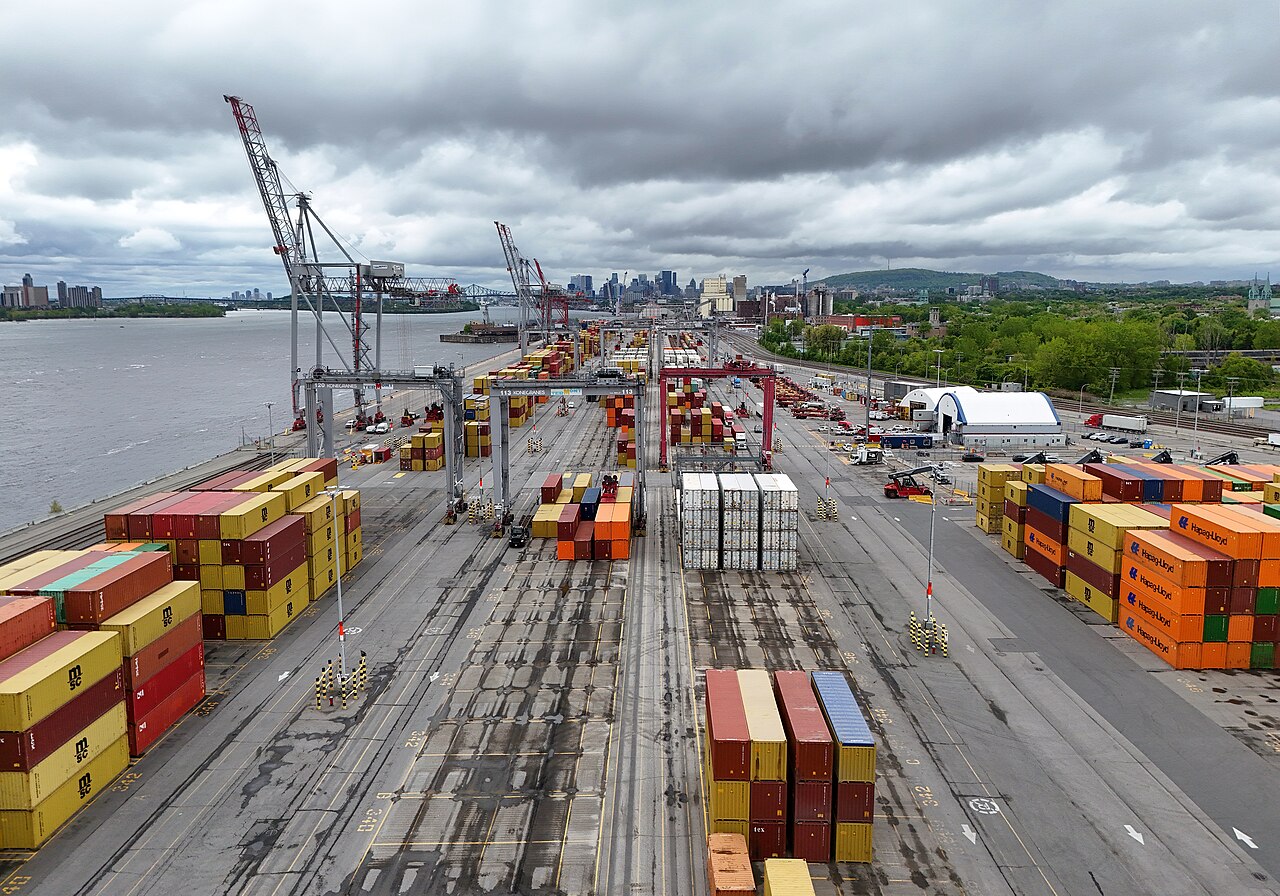
A place of trade: MontrealContainers at the Port of Montreal, May 2025. The port illustrates a place where goods can move between forms of transport.Photograph · Quintin Soloviev · Wikimedia Commons · CC BY 4.0 · Cropped on screen; image resized for the web.
Services: work people use
In plain language
Service industries provide work such as health care, education, transportation, banking, tourism, communications and retail. Services help people and businesses, often without making a physical product.
Picture it
A nurse caring for a patient and a driver moving goods both work in service industries.
Ask yourself
Is teaching a service or a manufactured product?
Manufacturing: making products
In plain language
Manufacturing industries turn materials and parts into goods that can be sold in Canada or abroad. The official guide gives examples such as automobiles, machinery, paper, food and aerospace equipment.
Picture it
An auto plant assembles parts into vehicles. Those vehicles can be sold to buyers in Canada or another country.
Ask yourself
What is the difference between assembling a vehicle and transporting it?
Natural resources: work tied to land and water
In plain language
Natural resource industries include forestry, fishing, agriculture, mining and energy. They have shaped Canada’s development and remain important to many regional economies. Regions produce different resources, depending on their geography.
Picture it
Fishing supports work on the Atlantic coast; forestry supports work in many wooded regions. Farms produce food, and energy projects provide fuel or electricity.
Ask yourself
Name two natural resource industries and one region where one of them matters.
Trade connects the work
In plain language
Trade means buying and selling goods and services across borders. Canada sells products from its industries abroad and buys from other countries. The United States is a major trading partner, and Canada also trades with other countries. A product can depend on resource workers, factory workers and service workers before it reaches a buyer.
Picture it
A tree can become lumber or paper, travel by truck to a port or store, and be sold in Canada or abroad. Forestry, manufacturing, transportation and trade all contribute.
Ask yourself
How can one product involve all three industry types?
Follow a product
From tree to buyer
This example connects the three major industry types with trade. Each step represents real work; other products may take different paths.
01
Natural resources
A forestry worker supplies wood.
02
Manufacturing
A mill turns some of that wood into paper.
03
Services
People transport, store and sell the paper.
04
Trade
The paper can be sold in Canada or to buyers in other countries.
Remember: transport and sales are services, even when the item sold is a manufactured product.
A way to remember
Services help or move; manufacturing makes; natural resources come from land and water. Trade connects the work to buyers here and abroad.
Check your understanding
A teacher and an auto assembler work in which industry types?
Teaching is a service because it provides education. Assembling an automobile is manufacturing because it makes a product.
Why can natural resource work vary from one region to another?
Geography differs: forests, farms, fisheries, minerals and energy resources are found in different places. Those resources support different regional jobs.
How can trade link Canadian industries with the United States?
Canadian businesses can sell goods or services to US buyers, and Canadian buyers can purchase from US businesses. A traded product may involve resources, manufacturing and services along the way.
Help us improve this site with Firebase Analytics. We send page visits, broad diagnostic milestones and confirmed paid study purchases only if you agree. Privacy Policy