Independent practice site — not affiliated with Immigration, Refugees and Citizenship Canada or the Government of Canada. The official study guide is free on Canada.ca.
Follow the changes after the Second World War: a growing economy, a wider place in the world, more equal participation, two official languages, and new cultural and scientific achievements.
This independent lesson is a study aid. Discover Canada is the free official guide.
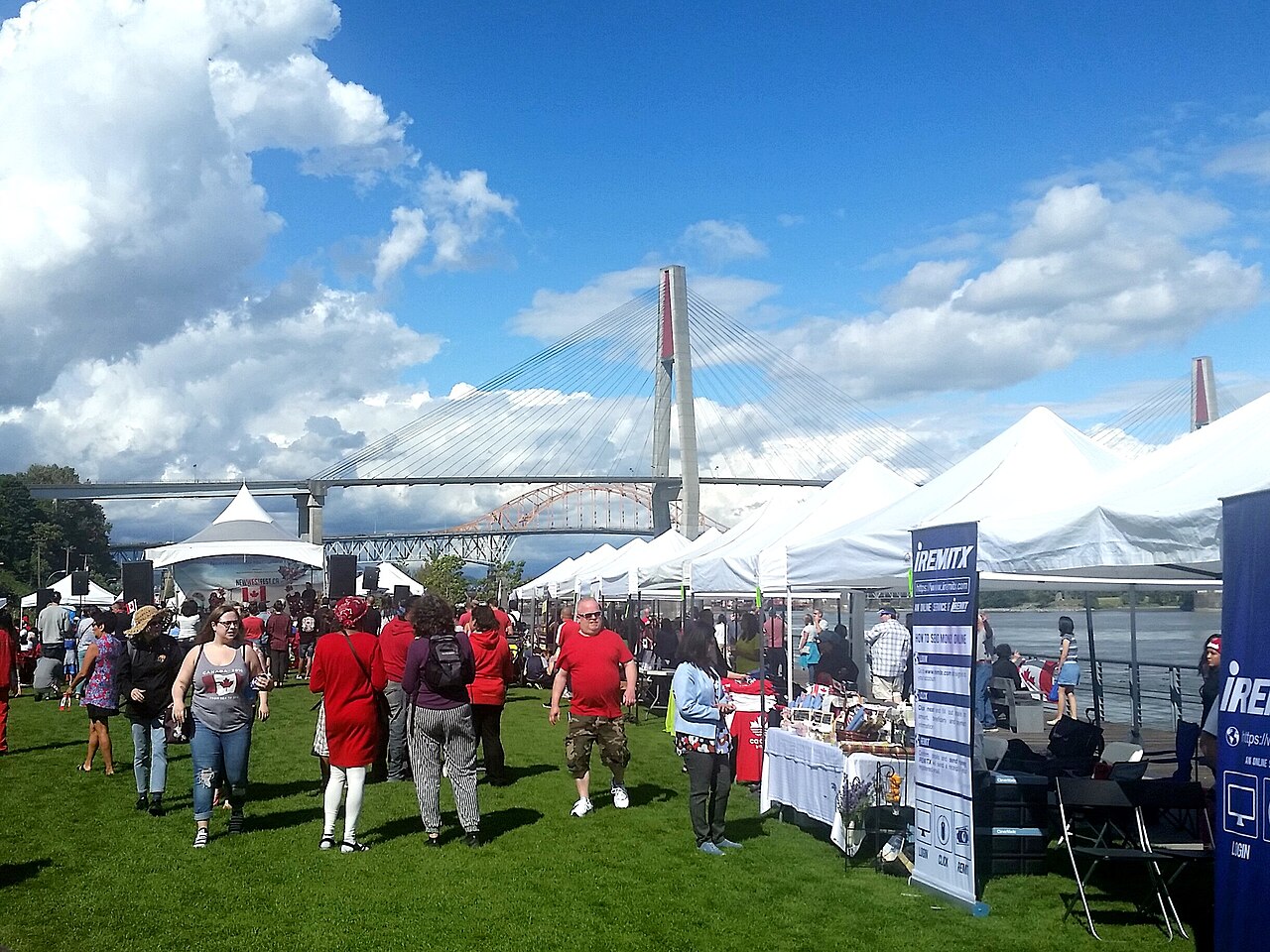
CANADA TODAY · IN ONE FRAMEOne community, many stories
New Westminster Multicultural Festival at Westminster Pier Park, New Westminster, British Columbia, 2018.Photograph · Mike / SqueakyMarmot · Wikimedia Commons · CC BY-SA 2.0 · Resized for the web; displayed with a CSS crop. Adapted image remains under CC BY-SA 2.0.
A community festival is one scene from contemporary Canada. It offers a place to think about cultural expression and neighbours meeting; it cannot stand in for every Canadian community.
After 1945: growth and social programs
In plain language
Trade and industry expanded after the war. Alberta oil discoveries helped build an energy industry. With greater prosperity, Canada developed and supported programs such as employment insurance and public pensions; provinces and territories provide publicly funded education.
Picture it
Connect the earlier Depression, when trade was restricted, with the postwar opening of trade. Economic growth helped support shared services.
Ask yourself
How did postwar prosperity help support social programs?
1948 and 1960: a wider vote
In plain language
Voting rights expanded over time. Japanese Canadians gained the federal vote in 1948, ending a remaining racial exclusion affecting Canadians of Asian descent. First Nations people gained the federal vote without having to give up Indian status in 1960. These dates show that equal political participation was achieved gradually.
Picture it
A right described for citizens today was denied to some citizens in earlier periods. Remember the dates as changes, not as proof that every earlier barrier vanished at once.
Ask yourself
Which voting-rights milestone came first: 1948 or 1960?
The 1960s: Quebec and official languages
In plain language
Quebec’s Quiet Revolution brought rapid social and political change. A federal commission on bilingualism and biculturalism preceded the Official Languages Act of 1969, which established federal services in English and French. Quebec sovereignty was debated and rejected in referendums in 1980 and 1995.
Picture it
The 1969 law concerns the federal government’s services; it does not mean every conversation or business transaction in Canada must use both languages.
Ask yourself
What change followed the federal bilingualism commission?
Canada in the world
In plain language
After the war, Canada joined the United Nations and NATO, took part in the Korean War and contributed to peacekeeping and other international operations. Its international role grew alongside the autonomy traced in the previous history lesson.
Picture it
Peacekeeping is one kind of international work; the guide also describes collective defence and the Korean War.
Ask yourself
Name one organization Canada joined after the war.
Culture, sport and science
In plain language
Canadian creators and researchers became known internationally. The guide highlights Inuit artist Kenojuak Ashevak, athlete and cancer fundraiser Terry Fox, and the Canadian-designed Canadarm used in space exploration. Their work belongs to different fields but each shaped how Canada is recognized.
Picture it
Terry Fox began his Marathon of Hope in 1980; the Canadarm later became a visible example of Canadian space engineering.
Ask yourself
Which example connects Canada with space exploration?
CONNECT THE MILESTONES
Then and now
Follow how the guide describes changes in political participation and public services. These milestones explain a path, not a claim that all barriers disappeared.
1948 → 1960
The federal vote widens
Japanese Canadians gained the federal vote in 1948. In 1960, First Nations people could vote federally without giving up Indian status.
After the Quiet Revolution in Quebec and a federal commission on bilingualism, the Official Languages Act established English and French services in the federal government.
Read the lesson map as a short timeline: postwar growth → 1948 and 1960 voting milestones → 1960s Quebec and 1969 official languages → a broader international and cultural role. Dates describe historical changes, not a snapshot of current statistics.
Check your understanding
Did social programs grow alongside postwar prosperity?
Yes. The guide connects economic growth with Canada’s ability to support social assistance programs.
Did the Quiet Revolution happen across all provinces?
No. The Quiet Revolution refers to rapid social and political change in Quebec during the 1960s.
What did the 1969 Official Languages Act concern?
It established English and French services in the federal government.
Help us improve this site with Firebase Analytics. We send page visits, broad diagnostic milestones and confirmed paid study purchases only if you agree. Privacy Policy