
Independent practice site — not affiliated with Immigration, Refugees and Citizenship Canada or the Government of Canada. The official study guide is free on Canada.ca.

← Study Guide
Lesson 5 · Based on Discover Canada

Canada's Past

Follow a few turning points in Canadian history. For each one, ask who was involved, what changed, and whose experience is missing from a simple date.

Read this section in the official Discover Canada guide ↗

This independent lesson is a study aid. Discover Canada is the free official guide.

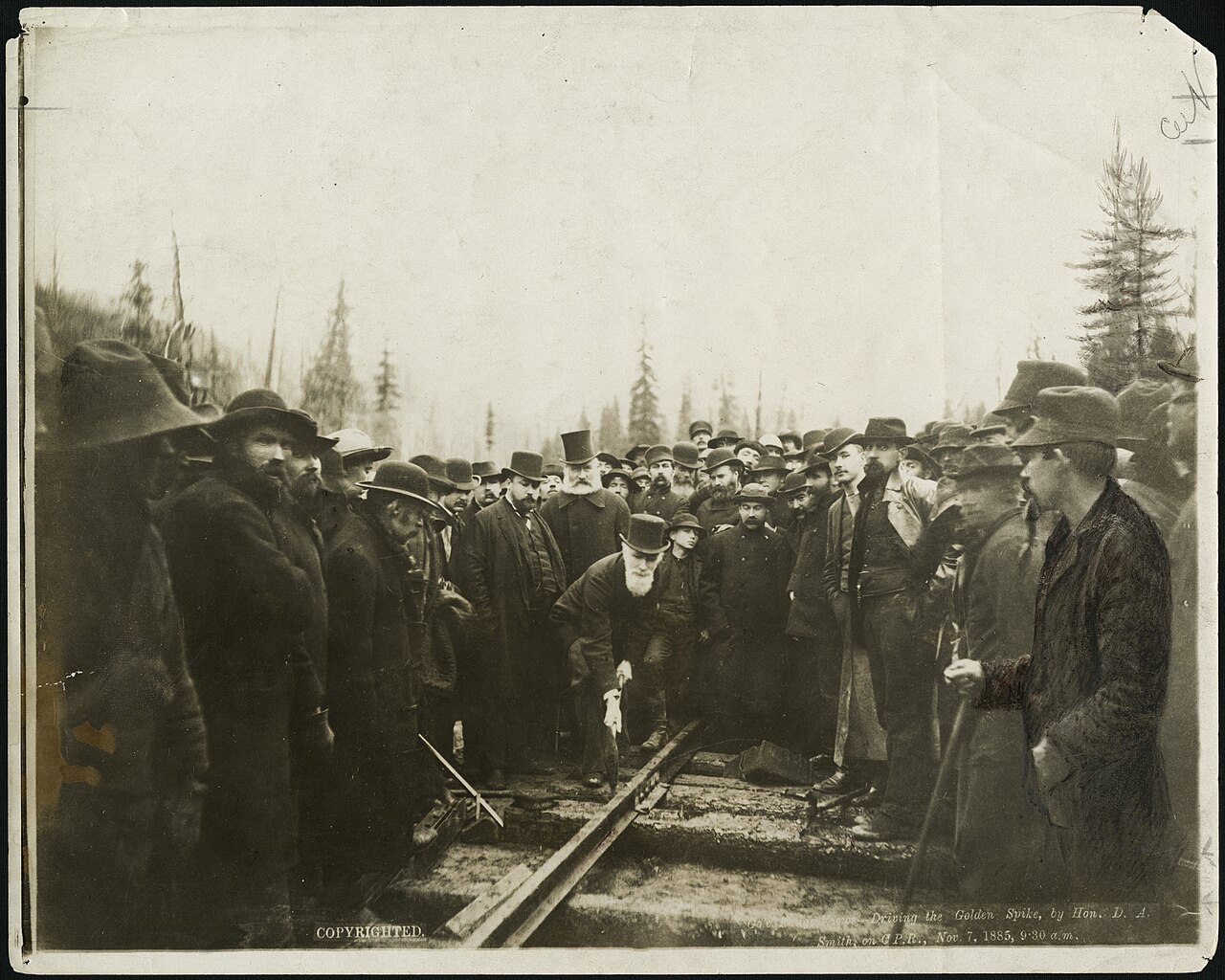
ARCHIVAL EXHIBIT · 1885
Donald A. Smith drives the ceremonial last spike of the Canadian Pacific Railway as a crowd watches beside the tracks.
The Last Spike · Craigellachie, British Columbia · 7 November 1885Library and Archives Canada C-003693 · Alexander Ross · Wikimedia Commons · Public domain in Canada and the United States · Resized for display; no crop

British Columbia joined Confederation in 1871 with a railway promise. The last spike in 1885 marked completion of the line. This ceremony does not show the essential labour of Chinese workers or the Indigenous peoples whose lands and rights were affected by western expansion.

Before European arrival: Indigenous homelands

In plain language

First Nations and Inuit communities lived throughout the lands now called Canada long before Europeans arrived. They had distinct languages, governments, economies and relationships with the land. Indigenous peoples remained central to later trade, diplomacy and defence.

Picture it

The Huron-Wendat farmed and hunted around the Great Lakes; Inuit communities drew on deep knowledge of Arctic land and sea. One story cannot stand for every people.

Ask yourself

Why must a timeline of Canada begin before European exploration?

1604–1608: New France and a changing continent

In plain language

A French expedition settled on Saint Croix Island in 1604, then built Port-Royal in Acadia in 1605 with help from the Mi’kmaq. Samuel de Champlain established Québec in 1608. New France grew through the fur trade and alliances with Indigenous peoples. European disease and colonization also caused devastating harm.

Picture it

A fur-trade route depended on Indigenous knowledge and partnerships; it was not simply a European achievement.

Ask yourself

What happened at Québec in 1608, and who made the fur trade possible?

1759–1814: British rule, migration and war

In plain language

Britain defeated France at Québec in 1759. The Quebec Act of 1774 preserved French civil law and allowed Catholics to hold public office. Loyalists, including Black and Mohawk Loyalists, arrived after the American Revolution. In the War of 1812, British forces, Canadian volunteers and First Nations allies resisted an American invasion.

Picture it

Chief Tecumseh and Shawnee allies fought alongside British and Canadian forces; the 1812 story includes Indigenous strategy and sacrifice.

Ask yourself

What did the Quebec Act protect, and who defended the colonies in 1812?

1848–1867: Responsible government and Confederation

In plain language

Reformers pressed for responsible government: ministers needed the support of elected representatives. Nova Scotia achieved it in 1847–48, followed by the Province of Canada. On July 1, 1867, Ontario, Quebec, Nova Scotia and New Brunswick formed the Dominion of Canada with federal and provincial governments.

Picture it

If a government loses the confidence of the elected assembly, it must resign. That principle grew out of nineteenth-century reforms.

Ask yourself

Which four provinces entered Confederation in 1867?

1869–1885: Expansion and resistance

In plain language

Western expansion did not happen on empty land. Métis people at Red River were not consulted when Canada acquired the northwest. Louis Riel led resistance, and Manitoba was created in 1870. The Canadian Pacific Railway was completed in 1885 with European and Chinese labour; Chinese workers then faced the discriminatory head tax.

Picture it

Remember the railway and Red River together: nation-building brought new links, but also dispossession and exclusion.

Ask yourself

Why did Métis people resist the 1869 transfer of the northwest?

1914–1945: War, rights and exclusion

In plain language

Canadians served in both world wars. The Canadian Corps captured Vimy Ridge in 1917; Canadian forces landed at Juno Beach in 1944 and helped liberate the Netherlands. Women won federal voting rights in stages during and after the First World War. Wartime governments also interned people and forcibly relocated Japanese Canadians.

Picture it

A date can carry more than one story: 1917 is remembered for Vimy Ridge and an early, limited expansion of women’s federal voting rights.

Ask yourself

Name one Canadian contribution to each world war and one wartime injustice.

Across this history: Indigenous rights and harms

In plain language

Treaties were not always respected. From the 1800s into the 1980s, the federal government placed many Indigenous children in residential schools, where languages and cultural practices were largely prohibited and children suffered harm. Indigenous peoples continued to defend their rights and communities.

Picture it

The official guide’s “Who We Are” section discusses residential schools. Place that history alongside Confederation and expansion, not outside the timeline.

Ask yourself

Whose voices and rights must remain visible when learning these dates?

HISTORY AT A GLANCEPeople and turning points
  1. Long before 1604Indigenous homelands
  2. 1604–05Saint Croix, then Port-Royal
  3. 1608Québec founded
  4. 1759British victory at Québec
  5. 1812Invasion resisted
  6. 1848Responsible government
  7. 1867Confederation
  8. 1870Manitoba and Métis resistance
  9. 1885Railway completed
  10. 1917Vimy Ridge
  11. 1944Juno Beach
Original, simplified timeline: these events are not the whole history. Sources: Canada’s History · Who We Are · Parks Canada: Port-Royal.

A way to remember

People before dates → contact and New France → British rule and 1812 → responsible government and 1867 → western expansion → world wars. At every step, ask whose land, labour and rights were involved.

Check your understanding

Did Canadian history begin with the arrival of Europeans?

No. First Nations and Inuit peoples had lived throughout these lands for thousands of years, with distinct communities and traditions.

What changed on July 1, 1867?

Ontario, Quebec, Nova Scotia and New Brunswick formed the Dominion of Canada under a federal system.

Why did Louis Riel and the Métis resist at Red River?

The Métis were not consulted about Canada’s acquisition of the northwest, and their land and political rights were at stake.

What is one reason to question a simple “progress” story of the railway?

It relied on Chinese workers who later faced discriminatory policies, while expansion also threatened Indigenous and Métis rights.

Official source

Read this section in the official Discover Canada guide ↗